
Note
Go to the end to download the full example code.
GONG PFSS extrapolation#
Calculating PFSS solution for a GONG synoptic magnetic field map.
import matplotlib.pyplot as plt
import numpy as np

import astropy.constants as const
import astropy.units as u
from astropy.coordinates import SkyCoord

import sunpy.map

from sunkit_magex import pfss
Load a GONG magnetic field map.
gong_fname = pfss.sample_data.get_gong_map()
gong_map = sunpy.map.Map(gong_fname)
The PFSS solution is calculated on a regular 3D grid in (phi, s, rho), where rho = ln(r), and r is the standard spherical radial coordinate. We need to define the number of rho grid points, and the source surface radius.
From the boundary condition, number of radial grid points, and source surface, we now construct an Input object that stores this information.
Using the Input object, plot the input field.
input_map = pfss_in.map
fig = plt.figure()
ax = fig.add_subplot(projection=input_map)
input_map.plot(axes=ax)
plt.colorbar()
ax.set_title('Input field')

INFO: Missing metadata for solar radius: assuming the standard radius of the photosphere. [sunpy.map.mapbase]

Text(0.5, 1.0, 'Input field')
Now calculate the PFSS solution.
pfss_out = pfss.pfss(pfss_in)
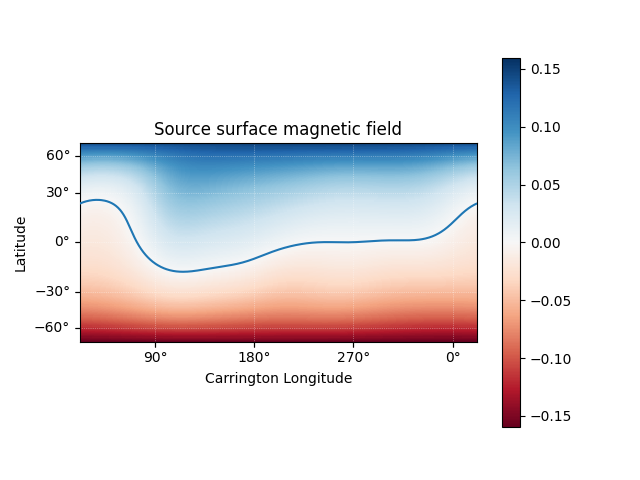
Using the Output object we can plot the source surface field, and the polarity inversion line.
ss_br = pfss_out.source_surface_br

fig = plt.figure()
ax = fig.add_subplot(projection=ss_br)

ss_br.plot(axes=ax)
# Plot the polarity inversion line
ax.plot_coord(pfss_out.source_surface_pils[0])
plt.colorbar()
ax.set_title('Source surface magnetic field')
Text(0.5, 1.0, 'Source surface magnetic field')
It is also easy to plot the magnetic field at an arbitrary height within the PFSS solution.
# Get the radial magnetic field at a given height
ridx = 15
br = pfss_out.bc[0][:, :, ridx]
# Create a sunpy Map object using output WCS
br = sunpy.map.Map(br.T, pfss_out.source_surface_br.wcs)
# Get the radial coordinate
r = np.exp(pfss_out.grid.rc[ridx])

fig = plt.figure()
ax = fig.add_subplot(projection=br)

br.plot(cmap='RdBu')
plt.colorbar()
ax.set_title('$B_{r}$ ' + f'at r={r:.2f}' + '$r_{\\odot}$')

Text(0.5, 1.0, '$B_{r}$ at r=1.50$r_{\\odot}$')
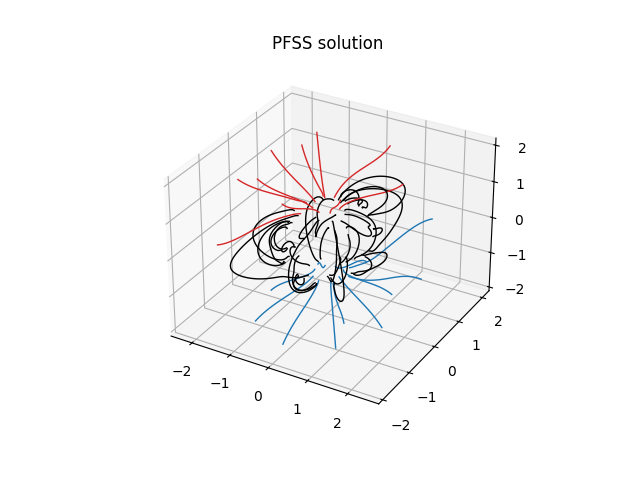
Finally, using the 3D magnetic field solution we can trace some field lines. In this case 64 points equally gridded in theta and phi are chosen and traced from the source surface outwards.
fig = plt.figure()
ax = fig.add_subplot(111, projection='3d')

tracer = pfss.tracing.PerformanceTracer()
r = 1.2 * const.R_sun
lat = np.linspace(-np.pi / 2, np.pi / 2, 8, endpoint=False)
lon = np.linspace(0, 2 * np.pi, 8, endpoint=False)
lat, lon = np.meshgrid(lat, lon, indexing='ij')
lat, lon = lat.ravel() * u.rad, lon.ravel() * u.rad

seeds = SkyCoord(lon, lat, r, frame=pfss_out.coordinate_frame)
field_lines = tracer.trace(seeds, pfss_out)
for field_line in field_lines:
    color = {0: 'black', -1: 'tab:blue', 1: 'tab:red'}.get(field_line.polarity)
    coords = field_line.coords
    coords.representation_type = 'cartesian'
    ax.plot(coords.x / const.R_sun,
            coords.y / const.R_sun,
            coords.z / const.R_sun,
            color=color, linewidth=1)
ax.set_title('PFSS solution')

plt.show()
/home/docs/checkouts/readthedocs.org/user_builds/sunkit-magex/conda/stable/lib/python3.12/site-packages/sunkit_magex/pfss/tracing.py:176: UserWarning: At least one field line ran out of steps during tracing.
You should probably increase max_steps (currently set to auto) and try again.
  warnings.warn(
Total running time of the script: (0 minutes 8.741 seconds)